Affiliate disclosure: As an Amazon Associate, Soccer Training Net earns from qualifying purchases. The Amazon product link on this page is an affiliate link.
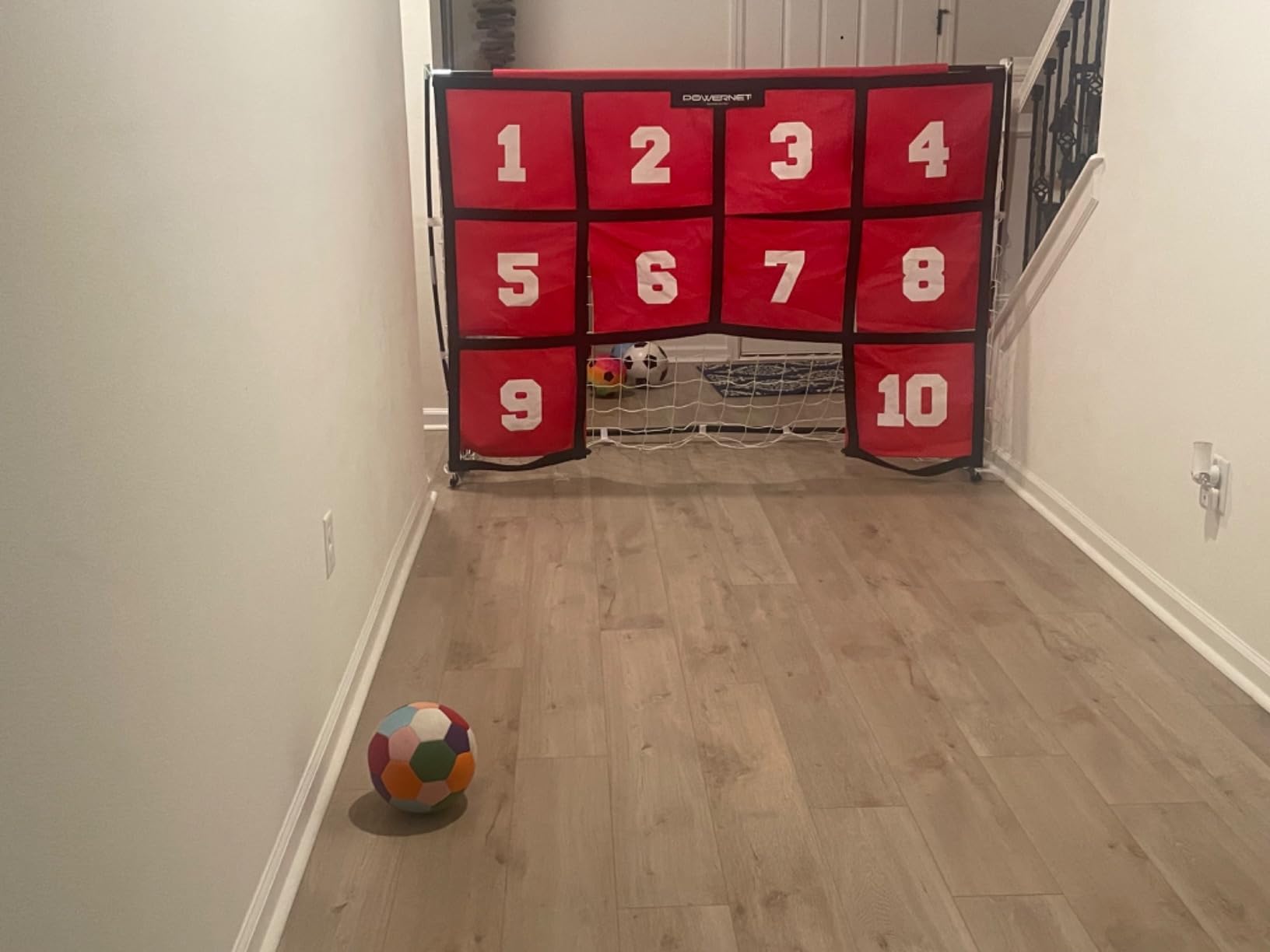
A numbered target goal becomes more useful when the player has a specific target, a fixed number of attempts, and a result to record. These five drills are designed for the PowerNet 6×4 Numbered Target Soccer Goal, but the same scoring ideas can be adapted to another clearly marked target goal.
There is no universal starting distance. Begin close enough for balanced technique and occasional target hits. Make a drill harder by changing one variable at a time: distance, required foot, ball movement, decision time, or target difficulty.
View the PowerNet target goal on Amazon ↗ · Is the PowerNet worth it?
Before starting
- Inspect the goal: assemble and stabilize it according to the manufacturer’s instructions. Keep the frame, net, and target panel clear of damage.
- Clear the area: no one should stand behind the goal or enter the shooting lane. Retrieve balls only after the round stops.
- Use a repeatable setup: record the surface, distance, ball, required foot, and number of attempts if you want to compare scores.
- Prioritize technique: move closer or reduce the pace when balance, contact, or control begins to deteriorate.
- Limit fatigue: allow enough time between attempts for a safe reset. More shots are not automatically better shots.
Drill 1: Call Your Target
Trains: intentional placement and repeatable accuracy.
Setup
Choose a comfortable shooting position and place ten balls beside the shooter. Before each attempt, the player announces one visible target number.
Rules and scoring
Take ten shots. Award 2 points for the called target, 1 point for a target directly beside it, and 0 points for every other result. Record both the total score out of 20 and exact hits out of 10.
Progression
Begin with the player choosing every target. Next, use a written sequence. Finally, have a partner call the target before the approach begins. Do not allow players to select only their easiest zone in every round.
Drill 2: Weaker-Foot Ladder
Trains: controlled placement and confidence with the non-dominant foot.
Setup
Select three targets at different heights or sides. Begin at a distance where the player can strike with balance using the weaker foot.
Rules and scoring
The player receives two attempts at each target. Completing all three targets creates one ladder rung. Move a small, measured distance farther away for the next rung. End the drill after a missed rung or a predetermined maximum of four rungs.
Record completed rungs and exact hits. The attempt limit keeps the drill finite and prevents one difficult target from turning the session into uncontrolled repetition.
Coaching cue
Use a smooth approach, place the support foot consistently, and favor controlled contact over maximum power. If technique becomes rushed or the player begins leaning away from the ball, return to the previous distance.
Drill 3: Around the Numbers
Trains: accuracy across the complete target panel and recovery after misses.
Setup
Write a sequence using all ten zones. It can run 1 through 10 or use a mixed order that alternates sides and heights.
Rules and scoring
Start at the first number and move forward only after an exact hit. Set a maximum of 25 total shots. The score is the number of targets completed; the tiebreaker is shots remaining.
For example, completing eight targets in 22 attempts scores “8 targets, 3 shots remaining.” A fixed shot cap is more useful than shooting indefinitely and makes results easier to compare.
Progression
After the player can complete the sequence consistently, alternate feet or move slightly farther away after target five. Change only one condition per round.
Drill 4: Pressure Ten
Trains: composure, resetting, and accurate execution within a controlled rhythm.
Setup
Place ten balls at the chosen position. Prepare a ten-number target list. A coach or partner can manage the sequence and confirm each result.
Rules and scoring
Take ten shots at a consistent interval that allows the player to recover safely, check the shooting lane, and reset technique. Call the assigned number before each attempt. Award one point only for the exact target.
Record correct-zone hits out of 10. The pressure comes from a finite scored round—not from rushing between balls. If the timer causes unsafe movement or poor mechanics, lengthen the interval or remove it.
Progression
Compare a normal round with a second round requiring alternating feet. Keep the distance and number sequence the same so the comparison remains meaningful.
Drill 5: First-Touch Finish
Trains: receiving, body adjustment, early decisions, and placement from a moving ball.
Setup
A partner stands safely outside the shooting lane and plays a controlled ground pass. The shooter begins from a marked position. Agree on the target number before the service.
Rules and scoring
Use one touch to prepare the ball and the next touch to shoot. Complete two rounds of eight services. Award 2 points for the called target, 1 point for an adjacent target, and 0 otherwise. Record each round separately.
Solo option
Use a suitable wall or rebounder positioned so that the returning ball travels into a safe finishing path. Check the surrounding area, surface, rebound angle, and equipment placement before starting.
Progression
Change the service angle or required foot only after the player controls the original version. First-time finishing is a later progression for consistently accurate service and suitable player technique.
Simple scorecard
| Drill | Primary score | Secondary result |
|---|---|---|
| Call Your Target | Points out of 20 | Exact hits out of 10 |
| Weaker-Foot Ladder | Completed rungs | Exact hits |
| Around the Numbers | Targets completed out of 10 | Shots remaining out of 25 |
| Pressure Ten | Exact hits out of 10 | Required foot or interval |
| First-Touch Finish | Points per eight serves | Exact hits per round |
Record the date, distance, surface, ball, foot requirement, and score. Repeat the same conditions before increasing difficulty. A better number matters only when the setup is reasonably consistent.
A balanced 40-minute session
| Block | Activity | Approximate time |
|---|---|---|
| Preparation | Goal inspection, light movement, ball touches, and comfortable unscored strikes | 8 minutes |
| Placement | Call Your Target | 7 minutes |
| Technique | Weaker-Foot Ladder | 8 minutes |
| Range | Around the Numbers | 9 minutes |
| Decision | Pressure Ten or First-Touch Finish | 6 minutes |
| Review | Record scores and identify one focus for the next session | 2 minutes |
This is a framework rather than a universal prescription. Adjust the number of shots, rest, ball size, distance, and session length to the player’s age, experience, current workload, and coaching guidance.
Common mistakes
- Moving back too quickly: increase distance only after accuracy and balance remain consistent.
- Changing several variables together: a harder distance, weaker foot, moving ball, and short timer make it impossible to identify what caused the score to change.
- Counting accidental targets: require a declared number so the score reflects intention.
- Chasing arbitrary benchmarks: compare the player with their own prior score rather than unsupported labels such as “elite.”
- Training through poor form: stop or simplify the drill when fatigue changes normal striking technique.
Final thoughts
The PowerNet’s numbers are most valuable when they create a repeatable decision and a score. Keep each drill finite, record the conditions, and progress one variable at a time. The goal is not merely to hit more balls; it is to produce more controlled attempts with a clear intention.
For related guidance, read our PowerNet value assessment, setup guide, and PowerNet versus rebounder comparison.