Affiliate disclosure: As an Amazon Associate, Soccer Training Net earns from qualifying purchases. Amazon product links on this page are affiliate links; manufacturer reference links are not.
The original draft correctly explained why accuracy matters, but it stopped at broad categories such as pocket nets, corner targets, and pop-up rebounders. Without named products, a reader could not compare the kind of feedback each net provides, the skill it trains, or the tradeoffs involved. This revised guide uses five specific models and separates shooting accuracy from passing, receiving, and return accuracy.
A target goal and a rebounder are not interchangeable. A target goal answers, “Did the shot reach the intended zone?” A rebounder is better for questions such as, “Can I repeatedly strike a smaller surface, control the return, and place my next touch?” Choose the feedback that matches the skill you want to measure.
Quick comparison
| Training net | Best accuracy use | Feedback | Main limitation |
|---|---|---|---|
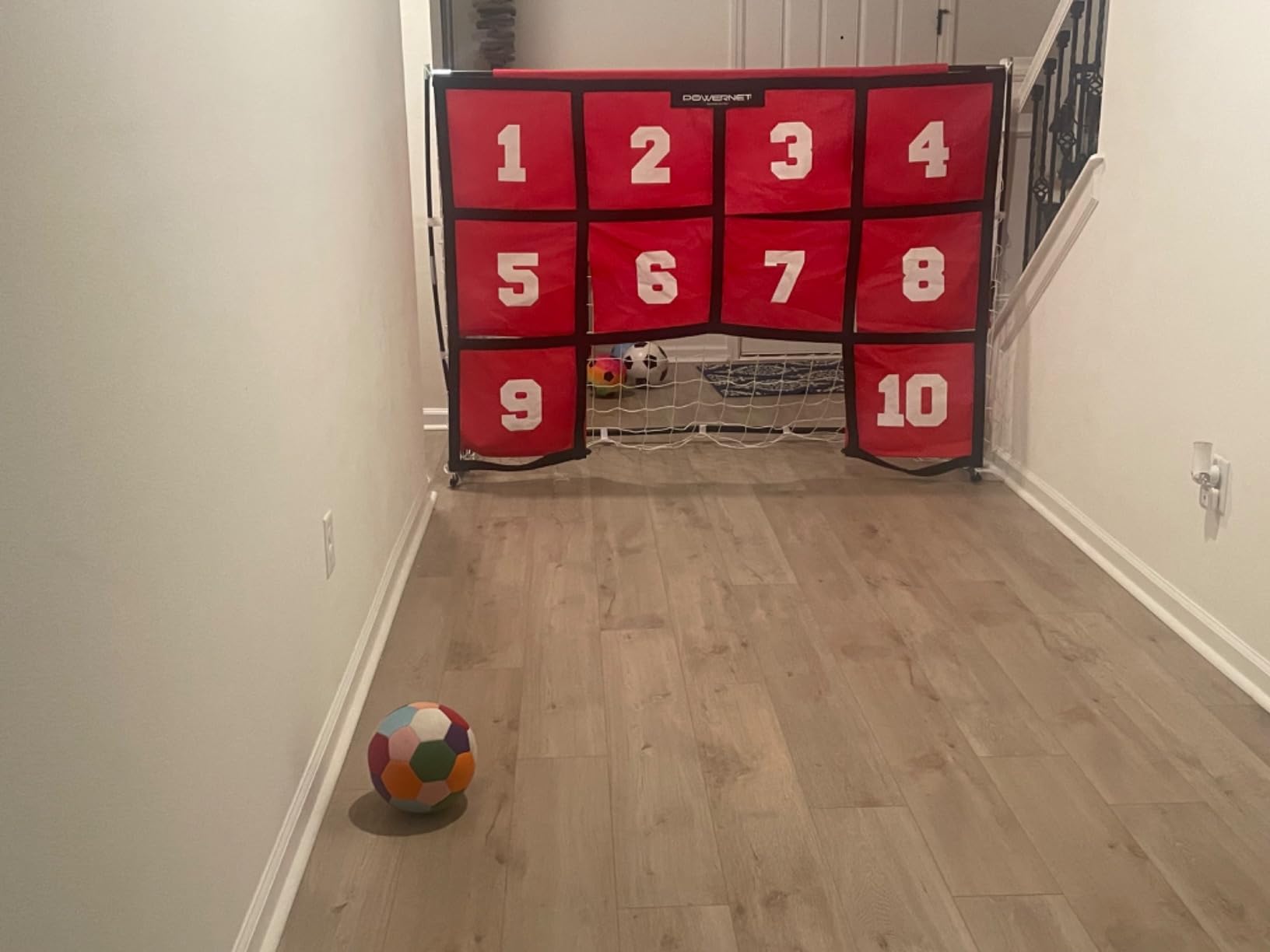
| PowerNet Numbered Target Soccer Goal | Shot placement | Ten numbered target zones | Smaller than a regulation goal |
| Kwik Goal CFR-2 Rebounder | Passing to a defined target | Outlined center target and adjustable return | Compact rebound surface |
| SKLZ Quickster Soccer Trainer | First touch after ground or aerial returns | Separate return surfaces | Not a corner-target goal |
| FORZA RapidFire Flash Pop-Up Rebounder | Portable repetition and reactions | Pop-up rebound surface | Return depends on setup and anchoring |
| Franklin Heavy Duty Steel Rebounder | Passing stations and team rotations | Large double-sided return area | Needs more space and storage |
1. PowerNet Numbered Target Soccer Goal
Best overall for measurable shooting accuracy. This 6×4-foot goal has ten numbered targets, each listed at approximately 14×15 inches. That makes it the clearest option here for calling a target before the shot, assigning point values, and recording correct-target hits instead of merely counting goals.
The design is especially useful for backyard, youth, and private-training sessions. Its compact size rewards precision, but it does not reproduce the angles or goalkeeper coverage of a regulation goal. Treat it as a dedicated placement station rather than a complete match simulation.
View PowerNet on Amazon ↗ · Read our full PowerNet review
2. Kwik Goal CFR-2 Rebounder
Best for passing accuracy and adjustable returns. The CFR-2 uses a 39×59-inch rebounding surface with an outlined center target. Players can aim passes at the marked area, then adjust the rebound angle to work on ground returns, lifted balls, receiving, or reaction drills.
This is a better fit for repeatable pass-and-receive work than for practicing finishes into goal corners. Its smaller target creates a useful accuracy challenge, while the adjustable angle adds variety without moving the entire station.
View Kwik Goal CFR-2 on Amazon ↗ · Manufacturer specifications ↗
3. SKLZ Quickster Soccer Trainer
Best for first-touch accuracy. The Quickster Soccer Trainer is designed for ground and aerial return work. Instead of measuring whether a shot reached a numbered goal zone, it lets a player practice sending a controlled pass into the net and directing the returning ball with the first touch.
A useful test is to place two small cone gates beside the player and alternate the gate through which the first touch must travel. This turns a general rebound session into a measurable receiving drill.
View SKLZ Quickster on Amazon ↗ · Manufacturer specifications ↗
4. FORZA RapidFire Flash Pop-Up Soccer Rebounder
Best for portable accuracy repetitions. The RapidFire Flash is a pop-up rebounder intended for ball-control, reaction, catching, and accuracy exercises. Its portability makes it practical for a coach or family that carries equipment between a backyard, park, and practice field.
Use a cone to mark the player’s starting position and count how many passes out of 20 strike the same central area. Because rebound behavior can change with anchoring, tension, surface, and pace, set the net up consistently before comparing scores across sessions.
View FORZA RapidFire Flash on Amazon ↗ · Manufacturer information ↗
5. Franklin Heavy Duty Steel Soccer Rebounder
Best for a large accuracy station. Franklin lists this steel rebounder at 12×6 feet and describes it as double-sided. The larger surface suits team rotations, longer passes, and exercises in which several players move through the same station.
The generous area is more forgiving than a compact target. To make accuracy measurable, mark smaller scoring zones with cones in front of the net or use tape or target accessories only when permitted by the manufacturer. Measure the available practice and storage space before buying.
View Franklin rebounder on Amazon ↗ · Manufacturer information ↗
Three accuracy drills that produce useful scores
Called-target ladder
Use the PowerNet’s numbered zones. Call five targets before starting and take two attempts at each. Score two points for the called target, one point for an adjacent target, and zero for a miss. Repeat from the same distance with the weaker foot and record both scores.
Pass, receive, and exit
With the SKLZ, Kwik Goal, or FORZA rebounder, place a cone gate to the left and right. Strike the net, receive the return, and direct the first touch through the called gate. Record successful passes and controlled exits separately so a good initial pass does not hide a poor first touch.
Twenty-ball consistency test
Choose one target area, one distance, and one type of strike. Take 20 attempts and record hits. Keep the ball, surface, net position, and setup as consistent as practical. Change only one variable—distance, foot, or target—during the next round.
What to look for before buying
Match the net to the definition of accuracy
For finishing, choose visible scoring zones. For passing, choose a defined rebound surface. For receiving, prioritize a useful and reasonably consistent return. For team drills, consider whether a larger surface will keep the station moving.
Check size, anchoring, and safe clearance
Confirm assembled dimensions, the space behind and around the net, and the anchoring method recommended for your surface. Ground stakes are not appropriate for every location, and “portable” does not guarantee that a net will fit every vehicle or storage area.
Do not assume more targets mean better practice
A ten-zone goal supports varied challenges, but one clearly defined target can be enough when the drill has a fixed distance and a recorded score. Consistency in setup and scoring matters more than adding complexity.
Final recommendation
For players whose main goal is shooting placement, the PowerNet Numbered Target Soccer Goal is the most direct choice because it provides ten explicit scoring zones. Choose the Kwik Goal CFR-2 for passing into a smaller target with adjustable returns, the SKLZ Quickster for first-touch direction, the FORZA RapidFire Flash for portable repetitions, or the Franklin steel rebounder for a larger group station.
No net improves accuracy by itself. The useful combination is a clearly defined target, repeatable setup, a fixed number of attempts, and a score the player can compare over time.