Affiliate disclosure: As an Amazon Associate, Soccer Training Net earns from qualifying purchases. The Amazon product link on this page is an affiliate link.
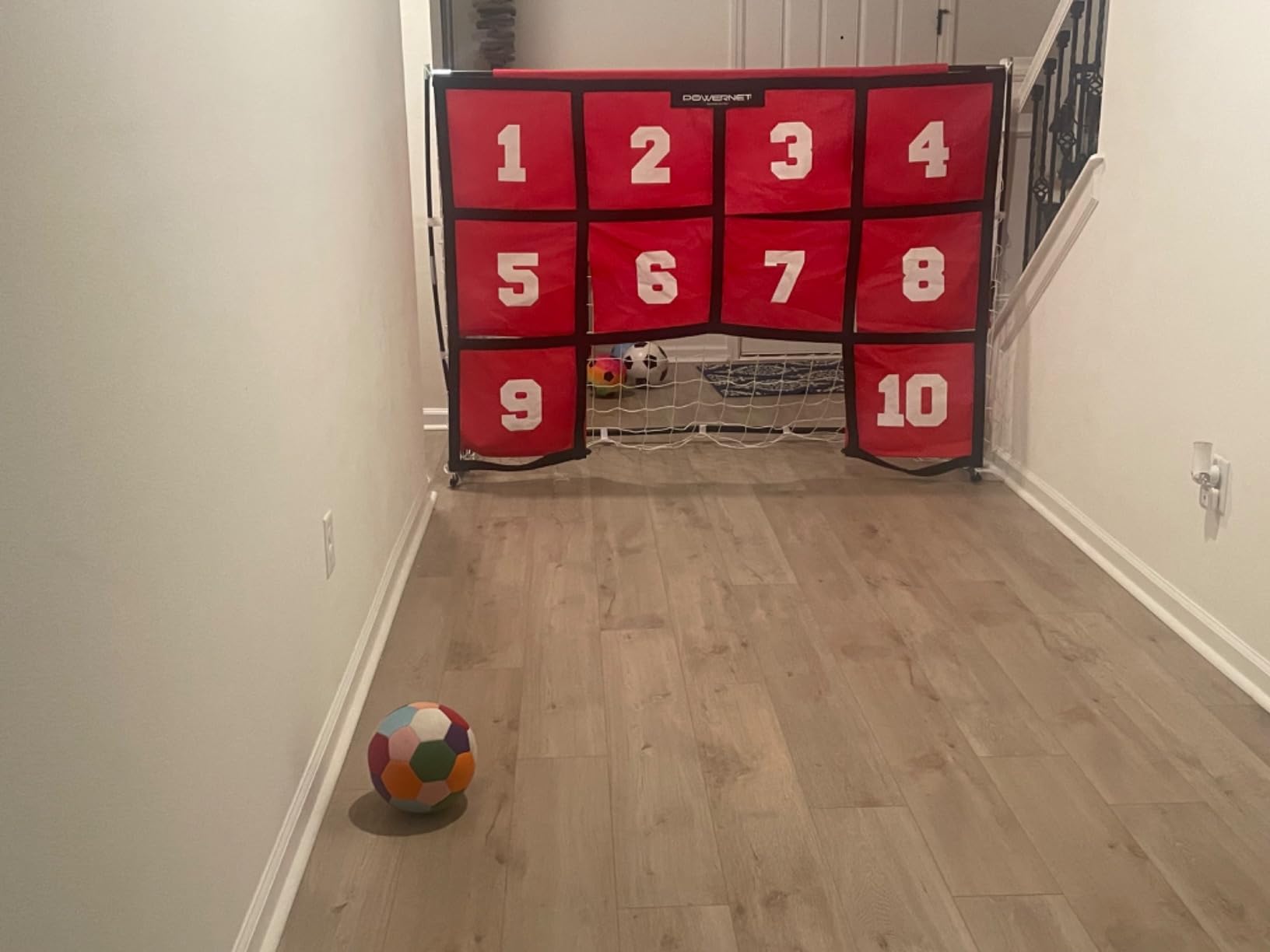
The useful question is not simply whether the PowerNet is “good.” It is whether this specialized target goal fits the training problem you need to solve. The product has ten numbered zones, each listed by PowerNet at approximately 14×15 inches. A rear net catches successful shots, while the lightweight frame, carry bag, and two handled sandbags support portable use.
Check the PowerNet goal on Amazon ↗ · Manufacturer specifications ↗
What are you actually paying for?
A plain portable goal gives a player an opening to shoot into. The PowerNet adds a fixed scoring system. A coach can call “7,” a player can attempt ten shots, and the result can be recorded as exact target hits. That small change gives a practice session a repeatable objective.
| Goal size | 6 feet wide × 4 feet high |
|---|---|
| Target system | Ten numbered zones, approximately 14 × 15 inches each |
| Ball behavior | Rear net catches successful shots; it does not return the ball |
| Portable features | Lightweight frame and heavy-duty canvas carry bag |
| Included support | Two handled weighted sandbags |
| Best training role | Measurable shot placement and competitive target games |
The numbered panel is therefore the main reason to pay more than you might for a basic pop-up goal. If you will not use the numbers to call, score, or sequence targets, much of the product’s added value disappears.
Five tests for deciding whether it is worth it
1. Will you measure the drills?
The goal provides clear feedback only when the session has a rule. Record correct-zone hits out of a fixed number of attempts, separate preferred-foot and weaker-foot scores, or time a target sequence. Simply shooting repeatedly at the panel may be enjoyable, but it does not automatically create useful progress data.
2. Is shot placement your priority?
The PowerNet is designed around finishing accuracy. It can help organize inside-foot placement, weaker-foot shooting, called-corner challenges, and competitive team stations. A rebounder is usually more versatile for passing, first touch, volleys, and receiving because it returns the ball.
3. Is a 6×4 goal appropriate for the session?
The compact opening increases the precision required to score. That is useful for controlled accuracy work and spaces where a larger goal is impractical. It cannot reproduce full-size goal dimensions, goalkeeper positioning, crossing patterns, or realistic far-post finishing. Players preparing for matches should transfer the skill to the goal size used in competition.
4. Will portability lead to more practice?
A portable goal can be valuable when it moves between storage, a backyard, a park, and team practice. PowerNet describes this model as lightweight and includes a carry bag. However, portability still involves assembly, stabilization, inspection, breakdown, and storage. If equipment setup routinely prevents training, a permanently installed option may be more practical where appropriate.
5. Will it complement—not replace—broader training?
A numbered target cannot teach a player when to shoot, how to read a goalkeeper, how to create space, or how to finish under defensive pressure. It works best as one station within a broader program that also includes ball mastery, passing, receiving, decision-making, small-sided play, and game-realistic finishing.
When the PowerNet offers strong value
- A player wants a defined target instead of shooting into an open goal.
- A parent wants repeatable backyard drills with scores that can be tracked.
- A coach needs a portable accuracy station for individual or team competitions.
- The player trains alone and benefits from written target sequences.
- The equipment can be stored indoors and brought out regularly.
- The buyer understands that the goal catches successful shots rather than rebounding them.
When it may not be the best purchase
- You primarily want passing, first-touch, or volley repetitions returned to the player.
- You need a regulation or age-appropriate match goal for scrimmages and goalkeeper work.
- You want a goal that remains assembled outdoors indefinitely.
- Your training facility already provides suitable target equipment.
- You mainly want a low-cost goal for casual play and would rarely use the numbered zones.
- You are unlikely to assemble, stabilize, inspect, and store portable equipment consistently.
Costs and tradeoffs buyers can overlook
Current price and availability
Do not base the decision on a fixed price quoted in an article. Retail prices, discounts, stock, package contents, and return terms change. Compare the current total cost with a plain portable goal and a suitable rebounder before buying.
Stability and safe placement
The included sandbags add support, but users still need to follow the manufacturer’s instructions and judge the surface, wind, clearance, and shot power. A lightweight portable frame should not be treated like a permanent anchored goal.
Storage
PowerNet states that its portable equipment should be taken down after use. Its warranty information excludes damage connected with improper storage, maintenance, and extended exposure to sun, wind, or rain. The time required to break down and store the goal is part of the ownership cost.
Ball supply
The rear net keeps successful shots near the station, but it does not return them to the shooter. Using several balls makes a structured session flow more smoothly than stopping after each attempt.
PowerNet target goal versus common alternatives
| Equipment | Best for | Main limitation |
|---|---|---|
| PowerNet numbered target goal | Called-zone shooting and measurable placement | No ball return; compact match simulation |
| Traditional rebounder | Passing, first touch, volleys, and repeated returns | Usually lacks ten clearly numbered finishing targets |
| Plain portable goal | Casual shooting and small-sided play | Less built-in feedback for precise placement |
| Match-size goal | Realistic angles, goalkeeper work, and team finishing | Requires considerably more space and may not be portable |
For a closer comparison, see our PowerNet target goal versus rebounder guide and our article on whether a 6×4 goal is large enough for training.
Three drills that help justify the purchase
- Called-zone score: Choose a number before each shot. Take ten attempts and award one point only for an exact hit. Record distance, foot used, and score.
- Both-feet comparison: Take ten attempts with the preferred foot and ten with the weaker foot from the same position. Track the two scores separately.
- Random decision finish: A partner calls a target after the player begins the approach. Use a safe pace and enough decision time to preserve balanced technique.
More detailed progressions are available in our five accuracy drills for a numbered target goal.
Frequently asked questions
Does the PowerNet rebound the ball?
No. A rear net catches shots that pass through the numbered targets. Players who want the ball returned for passing or first-touch repetitions should look at a rebounder.
Can beginners use it?
The target concept can be adapted for beginners by starting close, using a suitable ball, choosing larger or easier zones, and emphasizing balanced technique rather than shot power. Supervision and the manufacturer’s safety instructions remain important.
Can one person set it up?
PowerNet describes the goal as quick and tool-free to assemble. The frame uses tensioned components, so first-time users should read the included instructions, keep clear of pinch points, and avoid forcing pieces. Our PowerNet setup guide explains the general sequence.
Is it durable enough to leave outside?
It should not be treated as permanent outdoor equipment. PowerNet says its products are designed to be portable and taken down after use, and weather-related or storage-related damage may not be covered.
How long before accuracy improves?
No responsible article can promise a timeline. Progress depends on current skill, practice quality, repetition, feedback, rest, and whether target work transfers to realistic play. Consistent scores can show whether the drill result is improving, but match performance must be evaluated separately.
Final verdict
The PowerNet Numbered Target Soccer Goal is worth considering when measurable finishing accuracy is the buyer’s main objective. The ten numbered zones give players and coaches a simple way to call targets, record exact hits, and build competitive drills. Its rear catch net, carry bag, and included sandbags make it practical for portable training.
It is not automatically the best value for every player. Choose a rebounder for return-pass work, a plain goal for casual play, or an appropriate match-size goal for realistic goalkeeper and team finishing. The PowerNet earns its value only when its numbered targets are used consistently and safely.
For additional detail, read our complete PowerNet review and PowerNet pros-and-cons assessment.