Affiliate disclosure: As an Amazon Associate, Soccer Training Net earns from qualifying purchases. The Amazon product link on this page is an affiliate link.
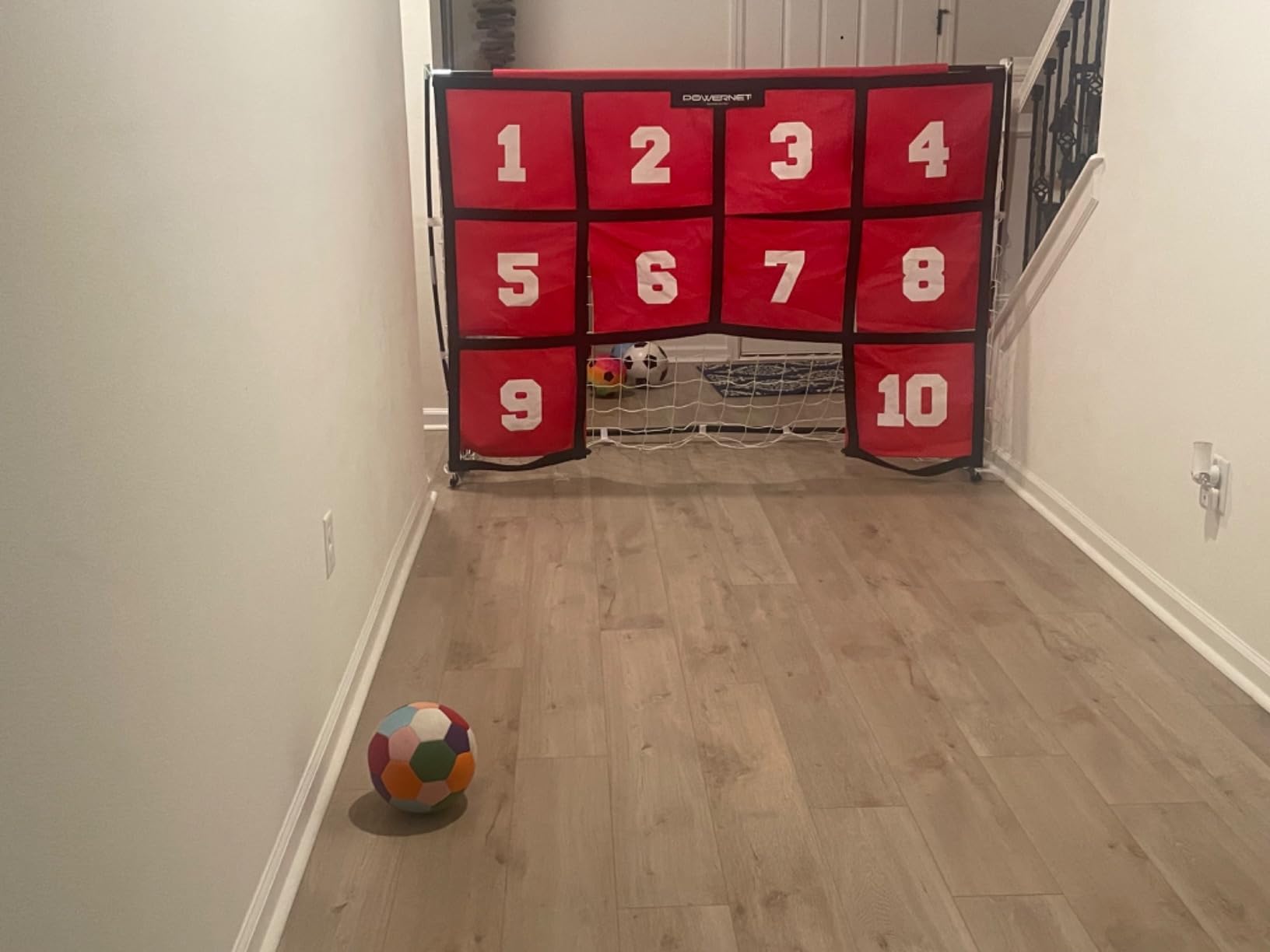
The PowerNet Numbered Target Soccer Goal is a portable 6×4-foot training goal with ten numbered target zones. PowerNet lists each target at approximately 14×15 inches. A rear net catches shots that pass through the targets, and the package includes a carry bag and weighted sandbags for added support.
Those details matter because the original draft described a broad family of “PowerNet numbered nets” with corner pockets and made claims about rust-proof materials, weather resistance, popularity, price, and long-term durability that were not tied to this exact model. This review focuses only on the PowerNet 6×4 Numbered Soccer Target Goal, SKU 1236, and separates verified features from reasonable training judgments.
View the PowerNet target goal on Amazon ↗ · Manufacturer specifications ↗
PowerNet specifications at a glance
| Goal size | 6 feet wide × 4 feet high |
|---|---|
| Targets | Ten numbered zones |
| Approximate target size | 14 × 15 inches each |
| Ball behavior | Rear net catches successful shots; it is not a rebounder |
| Included portability feature | Heavy-duty canvas carry bag |
| Included support | Two handled weighted sandbags |
| Intended use | Solo or team accuracy training and competitive target games |
Confirm the current package contents, warranty, availability, and return terms with the seller before purchasing.
The pros
1. Ten targets make accuracy measurable
The strongest advantage is not simply that the goal has targets; it is that each one has a number. A coach can call a zone before the shot, a player can record exact hits, and two sessions can use the same rules. That is more useful than taking an undefined series of shots into an open goal.
2. The rear net reduces retrieval after successful shots
When the ball passes through a target, the rear net catches it. This does not create continuous rebound repetitions, but it can keep successful shots near the training station and make a multi-ball session easier to organize.
3. It supports both solo and coached drills
A player training alone can follow a written target sequence, compare feet, or complete a scorecard. A coach can call random numbers, assign point values, or run team competitions. The same equipment can support structured technical work or a more playful family challenge.
4. The compact goal increases target difficulty
A 6×4 opening demands more precision than a large open goal. This can be useful for weaker-foot training, controlled finishing, and placement drills. The smaller frame is a benefit when the purpose is accuracy, even though it becomes a limitation for match simulation.
5. Portability is built into the product
The manufacturer describes the frame as lightweight and includes a canvas carry bag. That makes the product easier to move between storage, a suitable backyard, and a practice field than a permanent goal. “Portable” does not mean effortless for every user, so buyers should still check packed dimensions and handling requirements.
6. Included sandbags address stability
The two handled weighted sandbags are a meaningful inclusion because a lightweight goal needs support. They do not eliminate the need to follow the setup instructions, assess wind, maintain safe clearance, or use the correct anchoring method for the surface.
7. Difficulty can progress without buying another target system
A player can begin close to the goal with an early target call, then progress by increasing distance, delaying the call, requiring the weaker foot, or receiving a moving ball. Changing only one variable at a time keeps the drill measurable.
8. Replacement support appears to be available
PowerNet provides a replacement-parts route for its 6×4 goals. That can improve long-term practicality, although buyers must select the correct model and should verify current part availability and return restrictions.
The cons
1. A 6×4 goal is not match-size simulation
The compact frame cannot reproduce the width, height, far-post space, shooting angles, or goalkeeper coverage of a full-size goal. Older or advanced players can still use it for precision, but they also need practice on the dimensions used in their competition.
2. It catches the ball instead of returning it
This is a target goal, not a rebounder. It is well suited to finishing, but it does not send the ball back for one-touch passing, receiving, volleys, or repeated first-touch work. Players seeking those skills should consider a product such as the SKLZ Quickster or Kwik Goal CFR-2.
3. It trains only part of finishing
Hitting a numbered target is not the same as reading a goalkeeper, defender, ball speed, or match situation. A player may improve a controlled drill score without automatically improving decisions during competition. Use the net as one station within broader technical and game-based training.
4. Ball retrieval is reduced, not eliminated
The rear net catches successful target shots, but misses still require retrieval. Players who train with only one ball will not get the uninterrupted rhythm offered by a rebounder. Several balls and an organized collection point can make sessions smoother.
5. Lightweight portability creates a stability tradeoff
A product that is easier to carry will not behave like a permanent, deeply anchored goal. The included sandbags add support, but users must still follow the manufacturer’s instructions, use appropriate anchoring for the surface, and stop training when weather or field conditions are unsafe.
6. It should not be left outside indefinitely
The draft’s claim of all-season weather resistance is too broad. PowerNet describes its equipment as portable and says it should be taken down after use. Its published warranty information excludes normal wear and damage associated with improper storage, maintenance, or extended sun, wind, and rain exposure.
7. Ten fixed zones can make training repetitive
The target locations do not change. Without variations in distance, angle, service, required foot, and decision timing, players may repeat a familiar pattern rather than adapt. This is a programming limitation, not necessarily a product defect.
8. Setup is still part of every session
The manufacturer advertises tool-free, quick setup, but “quick” is subjective. Flexible poles, fabric, tension, sandbags, and storage all require handling. A permanent goal may be more convenient for a fixed training area, while the PowerNet makes more sense when portability matters.
9. Value depends on how often the numbered targets are used
The added value lies in the ten-zone system. If the buyer mainly wants casual small-sided games, a simpler portable goal may be sufficient. If the goal is passing and first touch, a rebounder may be a better use of the equipment budget. Compare current prices rather than assuming this category is always cheaper.
Pros and cons summary
| Advantages | Limitations |
|---|---|
| Ten numbered zones create measurable drills | 6×4 frame does not simulate a full-size goal |
| Rear net catches successful shots | Does not return the ball like a rebounder |
| Suitable for solo, coached, and competitive games | Does not replace goalkeeper reads or game decisions |
| Carry bag supports transport and storage | Requires setup, breakdown, and storage |
| Sandbags provide added support | Lightweight equipment still needs careful stabilization |
| Difficulty can scale through drill design | Fixed zones can become repetitive without variation |
Who should consider buying it?
- Players whose main goal is improving shot placement.
- Parents looking for a structured backyard accuracy station.
- Coaches who want a numbered finishing competition or measurable station.
- Players working separately on preferred-foot and weaker-foot accuracy.
- Users who need equipment that can be packed away after training.
Who may be better served by something else?
- Players mainly training passing, first touch, and volleys should consider a rebounder.
- Goalkeepers needing competition positioning and diving distances need the appropriate match-size goal.
- Teams running realistic crossing and far-post finishing need a larger goal.
- Buyers seeking only casual games may not need the numbered target system.
- Anyone unwilling to set up, stabilize, inspect, and store portable equipment should consider a fixed alternative where suitable.
How to get more value from the PowerNet
- Record exact hits: use a fixed number of attempts instead of shooting until success.
- Separate both feet: track preferred-foot and weaker-foot scores independently.
- Change one variable: progress distance, target, required foot, or decision time—not all at once.
- Add a moving ball: use controlled passes after stationary technique is consistent.
- Transfer the skill: follow target work with finishing against a goalkeeper or on the competition goal when appropriate.
- Store it correctly: take the portable goal down after use and follow PowerNet’s maintenance guidance.
Final verdict
The PowerNet Numbered Target Soccer Goal does one job especially well: it gives players a specific, measurable place to aim. The ten numbered zones, rear catch net, carry bag, and included sandbags make it a practical accuracy station for solo work, family practice, and coaching sessions.
Its limitations are equally clear. It is smaller than a match goal, does not rebound the ball, cannot provide technical feedback, and should not be treated as permanent all-weather equipment. Buyers who understand those boundaries are more likely to use it effectively.
For a deeper product overview, read our complete PowerNet review. You can also see our five numbered-target drills, 6×4 goal-size guide, and PowerNet versus rebounder comparison.