Affiliate disclosure: As an Amazon Associate, Soccer Training Net earns from qualifying purchases. The Amazon product link on this page is an affiliate link.
There is one important measurement correction to make first: in common soccer-product naming, 6×4 usually means approximately six feet wide by four feet high. It does not normally mean six feet high by four feet wide. Always check the manufacturer’s assembled dimensions rather than relying only on the product name.
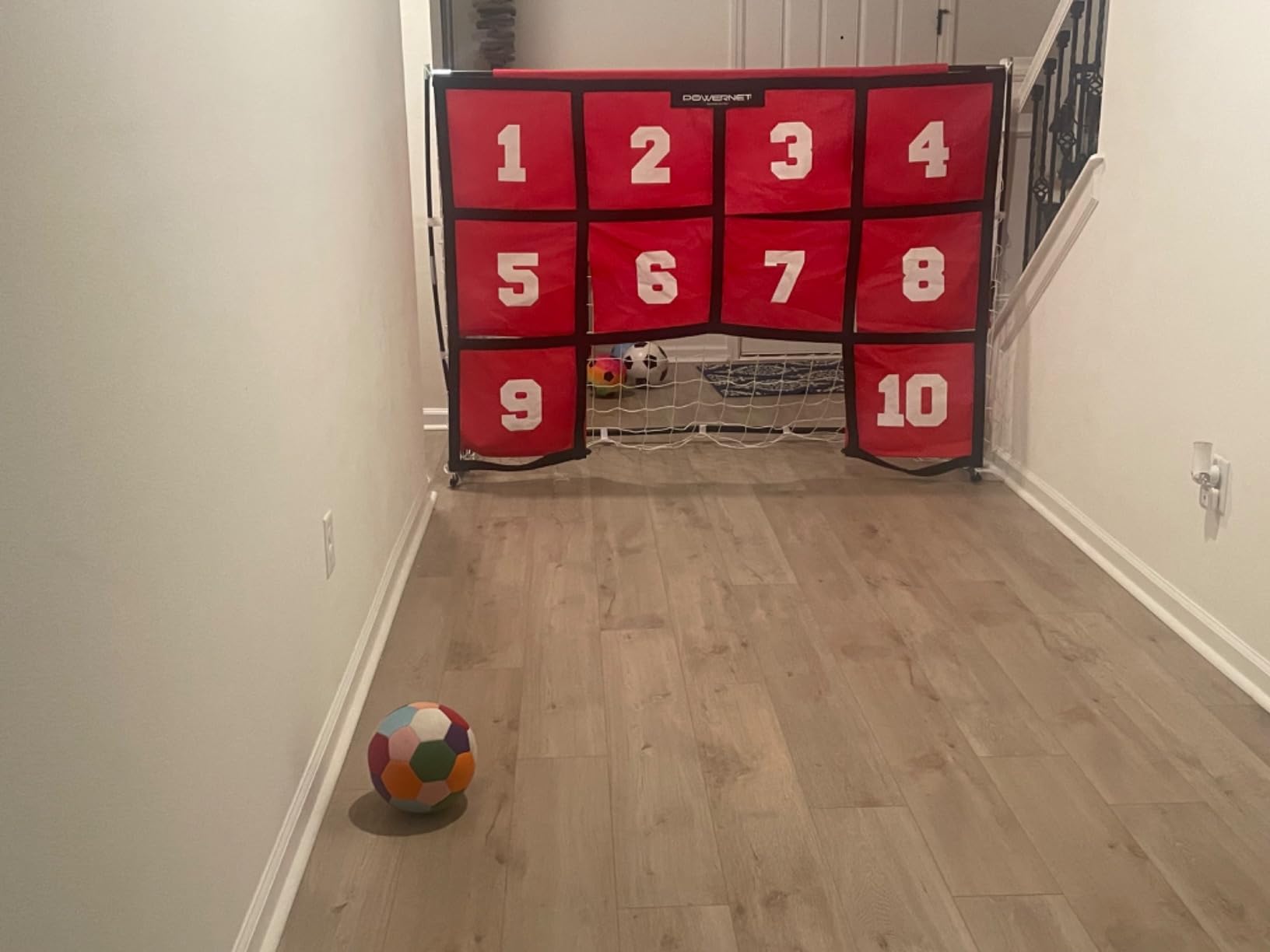
This guide focuses on the PowerNet 6×4 Numbered Target Soccer Goal. Its ten numbered zones make it more specialized than a plain mini goal: the reduced opening and visible targets are intended to turn shooting into a measurable accuracy exercise.
View the PowerNet 6×4 target goal on Amazon ↗ · Read our full PowerNet review
Why a 6×4 goal can be an effective training size
1. A smaller opening rewards placement
A player cannot rely on simply keeping the ball somewhere inside a large frame. The compact goal encourages a deliberate target, controlled contact, and a repeatable starting position. On the PowerNet model, a coach can call one of ten zones and record exact hits over a fixed number of shots.
That makes the goal useful for accuracy practice, but the benefit comes from the drill design—not from the idea that a smaller goal automatically improves technique.
2. It fits training spaces that cannot hold a match goal
A 6×4 goal can be practical in a suitable backyard, training area, or section of a field. The goal itself is only part of the space requirement. Players also need a safe shooting lane, room behind and beside the net, clearance from windows and bystanders, and an anchoring method appropriate for the surface.
3. It supports frequent, repeatable practice
A compact goal that can be stored and set up consistently may be used more often than a larger goal that is difficult to move. Repetition is valuable when the player keeps the distance, target, ball, and scoring rules consistent enough to compare sessions.
4. It can reduce the difficulty for new goalkeepers—but with limits
A small goal can support basic ready-position, handling, reaction, and close-range exercises when coaching and safety are appropriate. It does not teach the full positioning, movement range, high-ball decisions, or diving distances required by larger match goals.
Where a 6×4 goal falls short
1. It does not reproduce a full-size scoring area
A full-size goal is dramatically wider and taller. A 6×4 net cannot recreate far-post finishing, broad changes in shooting angle, or the amount of space a goalkeeper must protect. Players preparing for full-size competition should also train on the goal dimensions they will actually face.
2. Long-range shooting can become the wrong challenge
Moving farther away does not always make a drill better. At some point, the small goal may reward simply getting the ball on frame rather than selecting realistic match targets. If technique becomes rushed or players repeatedly strike at maximum power with little control, move closer or use a larger goal.
3. Crossing and wide-angle finishing are restricted
Crosses, cutbacks, and diagonal attacks depend on the relationship between the ball, goal width, goalkeeper, and far post. A compact net can still serve as a finishing point, but it cannot reproduce the complete geometry of those situations.
4. It is not automatically the correct match goal for a particular age
Youth goal dimensions and small-sided formats vary by age group, competition, and local organization. Do not assume that a 6×4 training goal matches league requirements simply because it is marketed for youth players. Check the current rules supplied by the team or competition.
What can you train well with a 6×4 goal?
| Training objective | 6×4 suitability | Important limitation |
|---|---|---|
| Called-target accuracy | Excellent with numbered zones | Measures precision, not match realism |
| Weaker-foot finishing | Very useful | Begin at a manageable distance |
| First-time finishing | Useful with controlled service | Compact width limits crossing angles |
| 1v1 finishing | Useful for constrained drills | Needs safe spacing and age-appropriate contact |
| Informal small-sided play | Often useful | Not automatically a regulation match size |
| Goalkeeper reactions | Useful for basic close-range work | Does not replace larger-goal positioning |
| Long-range shooting | Limited | Small frame may distort shot selection |
| Crossing and full-size tactics | Poor substitute | Goal width and angles are too restricted |
Five drills that fit a 6×4 target goal
1. Ten-zone scorecard
Take one shot at each numbered target from a fixed distance. Award two points for an exact hit and one for an adjacent zone. Repeat from the same location in a later session before increasing difficulty.
2. Preferred foot versus weaker foot
Take ten shots with each foot from the same starting point and toward the same set of targets. Record exact hits separately. This produces a more useful comparison than mixing both feet into one total.
3. Central, left, and right approaches
Mark three shooting positions. Take five controlled shots from each and call the target before the approach. Compare accuracy by angle rather than relying on one comfortable central position.
4. Pass, touch, finish
Receive a safe ground pass, take one touch into the shooting lane, and finish toward a called zone. Score the first touch and target hit separately so an accurate shot does not hide a poor setup touch.
5. Five-target pressure sequence
Select five zones and allow ten total attempts to hit them in order. The score is targets completed, with unused shots as the tiebreaker. This adds manageable pressure without turning the drill into a long fatigue test.
For full instructions and progressions, see our five numbered-target accuracy drills.
How far away should you shoot?
There is no single correct distance for every player. Start where the player can maintain balance, controlled contact, and occasional target success. If nearly every attempt misses the entire goal, the drill is probably too difficult to provide useful feedback. If nearly every shot reaches the called zone, move back slightly or add one new challenge.
Change only one variable at a time: distance, target difficulty, service speed, required foot, or decision time. This makes it easier to identify why the score changed.
Who is a 6×4 goal best for?
- Players who want a compact shot-placement station.
- Families with a suitable but limited practice area.
- Coaches running an accuracy or finishing station within a larger session.
- Players tracking preferred-foot and weaker-foot performance.
- Small groups using constrained, informal games where the chosen size is safe and appropriate.
Older and advanced players can still benefit from a small goal when the purpose is precision. The player’s age alone does not determine whether the equipment is useful; the key question is whether the drill matches the intended skill.
When should you choose a larger goal?
Use a larger or match-size goal when the session must reproduce competition angles, realistic goalkeeper positioning, long-distance finishing, crosses, cutbacks, or tactical movement around the penalty area. Goalkeepers in particular need experience with the dimensions they will defend in competition.
A useful setup may include both: the 6×4 target goal for technical accuracy stations and access to the appropriate match goal for transfer into realistic situations.
Buying and setup checklist
- Confirm that “6×4” means width by height for the exact product.
- Measure the assembled goal, safe shooting lane, and surrounding clearance.
- Check folded dimensions and storage needs.
- Use the manufacturer-approved anchoring or weighting method for the surface.
- Inspect the frame, net, targets, joints, and anchors before each session.
- Check whether the goal is a training product or approved for the intended competition.
- Compare replacement parts, warranty terms, and current return policy.
Final verdict
Yes—a 6×4 soccer goal is big enough for useful training when the objective is accuracy, finishing technique, weaker-foot repetitions, or compact practice. The PowerNet’s ten numbered zones make that purpose especially clear and measurable.
No—it is not large enough for every kind of training. It should supplement, not replace, practice on the goal dimensions used in competition when players need realistic shooting angles, crossing situations, or advanced goalkeeper development.
The best way to judge the size is not “Is the player too old for it?” but “Does this goal provide the right feedback for today’s drill?” For more context, read our PowerNet versus rebounder comparison and accuracy-net buying guide.