Affiliate disclosure: As an Amazon Associate, Soccer Training Net earns from qualifying purchases. Amazon product links on this page are affiliate links; manufacturer reference links are not.
The original draft had the right central idea: a PowerNet target goal and a soccer rebounder solve different training problems. However, it described “PowerNet” too broadly, did not name a rebounder, and made general price and durability claims that can vary by model. This revised guide compares the PowerNet 6×4 Numbered Target Soccer Goal with two specific rebounders—the SKLZ Quickster Soccer Trainer and Kwik Goal CFR-2.
The short answer is simple: choose the PowerNet when the main question is where did the shot finish? Choose a rebounder when the main question is what can the player do with the ball that comes back?
What the PowerNet Numbered Target Goal actually does
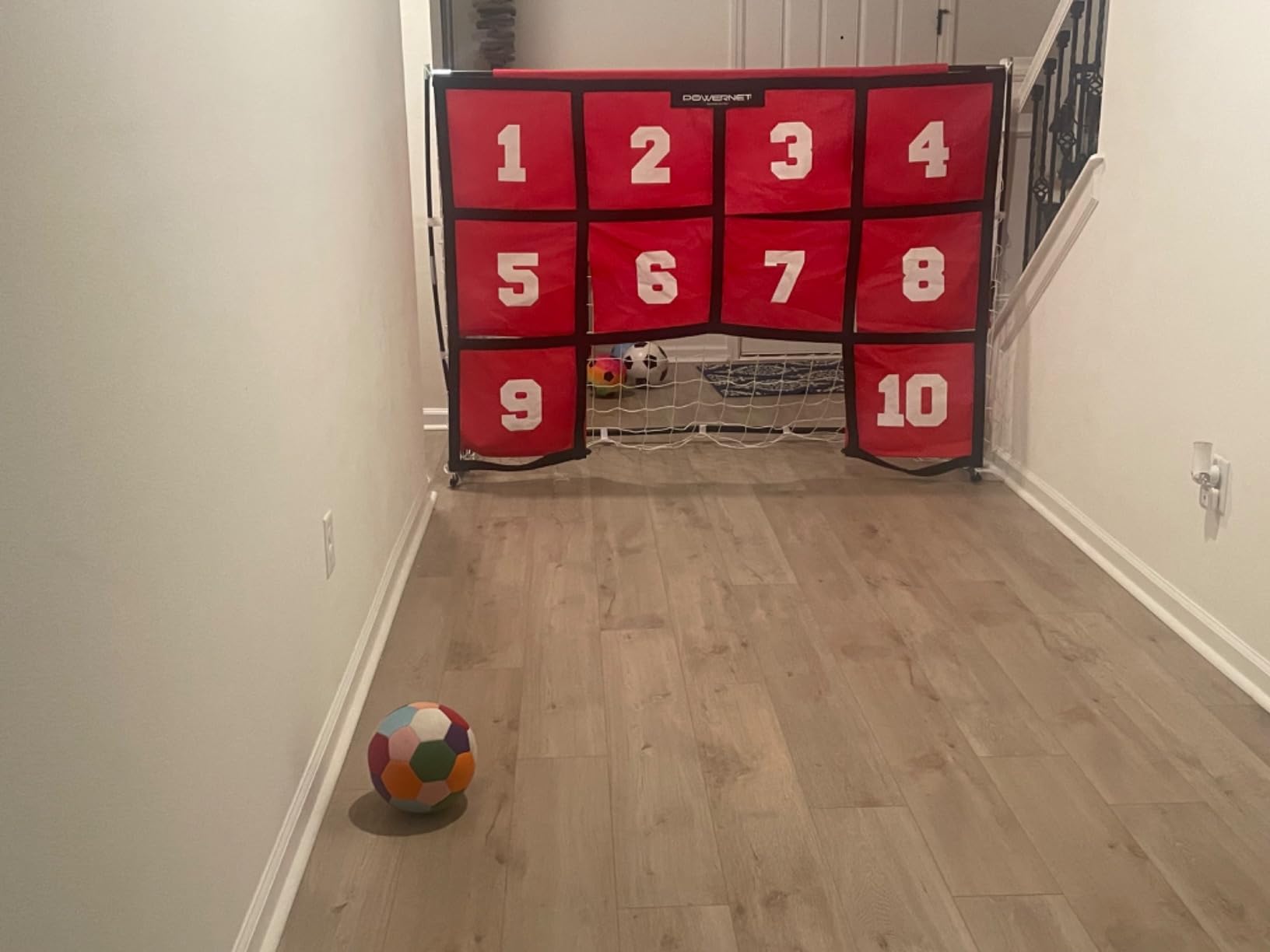
The PowerNet is a 6×4-foot target goal with ten numbered zones, each listed at approximately 14×15 inches. A player or coach can call a number before the shot, assign different point values, and record correct-target hits over a fixed number of attempts. The rear net catches successful shots rather than intentionally returning them for the next touch.
That design makes the PowerNet a finishing and shot-placement tool. It can add structure to backyard shooting, private lessons, and team competitions. Because it is smaller than a regulation goal, it should be treated as a precision station—not as a complete simulation of match angles, goalkeeper positioning, or full-size finishing.
View PowerNet on Amazon ↗ · Read our full PowerNet review
What a traditional soccer rebounder does
A rebounder uses net tension and frame angle to redirect the ball toward the player. Instead of ending the repetition, it creates the next action: receive, pass again, volley, turn, or direct the first touch into space. The pace and path of the return depend on the model, strike, tension, angle, anchoring, and surface.
“Traditional rebounder” is still a broad category, so it helps to compare real examples:
SKLZ Quickster Soccer Trainer
The Quickster is designed for passing, receiving, and settling balls on the ground and in the air. Its ground-return area supports pass-and-receive repetitions, while the upper return area can be used for volleys and aerial control. It is a better match for first-touch work than for measuring finishes into numbered goal zones.
View SKLZ Quickster on Amazon ↗ · Manufacturer specifications ↗
Kwik Goal CFR-2 Rebounder
The CFR-2 has a 39×59-inch face, an outlined center target, and an adjustable rebound angle. That smaller target can challenge passing accuracy, while the angle adjustment changes the type of return. It is useful when a player wants more control over the rebound path without moving the entire station.
View Kwik Goal CFR-2 on Amazon ↗ · Manufacturer specifications ↗
PowerNet vs. rebounder: head-to-head comparison
| Decision factor | PowerNet Numbered Target Goal | Traditional rebounder |
|---|---|---|
| Primary purpose | Finishing and shot placement | Passing, receiving, first touch, and reactions |
| Ball behavior | Catches a successful shot | Returns the ball toward the player |
| Feedback | Ten visible numbered target zones | Quality and direction of the return and next touch |
| Continuous repetitions | Usually requires ball retrieval or several balls | Designed for repeated actions from one ball |
| Best scoring method | Correct-target hits from a fixed number of shots | Accurate passes plus controlled returns through a cone gate |
| Useful solo skills | Placement, weaker-foot finishing, called-target shots | One-touch passing, receiving, volleys, reaction speed |
| Space pattern | Needs safe shooting distance and clearance behind the goal | Needs clearance for both the strike and the returning ball |
| Best choice when | The player needs a precise place to finish | The player needs the ball returned for the next action |
1. Shooting accuracy and finishing
Advantage: PowerNet. The ten numbered zones make the outcome obvious. A coach can call “2,” a player can aim for that zone, and the result can be scored immediately. With a rebounder, hitting the net shows that the ball reached the surface, but it does not recreate high and low scoring areas across a goal.
Use the PowerNet for called-corner work, weaker-foot placement, finishing competitions, and scorecards. Vary distance and approach only after the player can repeat the same setup consistently.
2. Passing and first touch
Advantage: rebounder. The returning ball creates a second technical problem. The player must adjust body shape, cushion or redirect the ball, and prepare the next pass. The SKLZ Quickster emphasizes ground and aerial returns, while the Kwik Goal CFR-2 adds a smaller center target and adjustable angle.
To make the drill measurable, record two outcomes separately: whether the initial pass struck the chosen area and whether the first touch traveled through a called cone gate.
3. Training rhythm and ball retrieval
Advantage: rebounder for high-repetition touches. A rebounder can produce a pass-return-pass rhythm without a partner. A target goal ends the repetition, so the player either retrieves the ball or works from a supply of several balls.
That does not make the rebounder automatically better. Finishing practice often benefits from a deliberate reset, especially when the player changes angle, checks the target, and rehearses a match-like approach before each shot.
4. Portability, setup, and anchoring
No universal winner. Portability depends on the specific product, not whether it is called a target goal or rebounder. Compare assembled and folded dimensions, total weight, carry-bag design, setup instructions, and the anchoring method permitted for the practice surface.
Ground stakes may work on suitable grass but not on concrete or indoor turf. A returning ball also requires safe clearance between the player, net, bystanders, and nearby property. Follow the manufacturer’s instructions rather than improvising an anchoring system.
5. Durability and maintenance
Compare components, not categories. It is too broad to say that all rebounders are tougher than target goals. Inspect the frame material, net, bungees or attachment points, stakes, replacement-part availability, warranty, and storage requirements for the exact model.
Repeated outdoor exposure can age nets, elastic parts, and finishes. Store equipment according to the manufacturer’s guidance and inspect it before training. Stop using a product if the frame, net, connectors, or anchors are damaged.
6. Cost and long-term value
Do not assume one category is always cheaper. Prices, promotions, sizes, and included accessories change. Compare the current total cost and ask whether the product supports the drills the player will actually repeat. An inexpensive target goal is poor value for a player who mainly needs first-touch work; an advanced rebounder is unnecessary if the only goal is scoring called-target shots.
Which one should you choose?
Choose the PowerNet Numbered Target Goal if:
- Shooting placement is the main priority.
- You want numbered zones for scoring drills and competitions.
- The player needs visual feedback about where a shot finished.
- You have safe space for shooting and ball retrieval.
Choose a traditional rebounder if:
- Passing, first touch, receiving, or volleys are the main priorities.
- You want repeated touches without a training partner.
- The player needs practice reacting to a returning ball.
- You can provide safe clearance for the rebound path.
Choose both if:
The budget, storage space, and training plan justify two specialized stations. A rebounder can begin the sequence with a pass and controlled first touch; the player can then turn and finish into a called PowerNet zone. That combination trains buildup and finishing without pretending that either product does both jobs equally well.
Three drills that make the differences clear
PowerNet called-zone test
Choose five numbered zones and take two shots at each from a fixed distance. Award two points for the called zone, one for an adjacent zone, and zero for a miss. Repeat with the weaker foot.
Rebounder two-part accuracy test
Mark a central aiming area on the rebounder only if the product already provides one or the manufacturer permits an accessory. Place cone gates to the player’s left and right. Score one point for an accurate pass and one for directing the first touch through the called gate.
Receive, turn, and finish
Pass into the rebounder, control the return, turn, and shoot at a called PowerNet number. Record the initial pass, controlled first touch, and target hit as three separate outcomes. This identifies the exact stage where the sequence breaks down.
Final verdict
The PowerNet Numbered Target Soccer Goal is the better choice for measurable shot placement. A traditional rebounder such as the SKLZ Quickster or Kwik Goal CFR-2 is the better choice for passing, receiving, first touch, and continuous solo repetitions.
Neither category replaces the other. Start with the player’s most important skill gap, available space, and practice routine. The best training net is the one that supplies the right feedback and gets used consistently.
For more options, see our five-net comparison by training goal and accuracy-net guide.