Affiliate disclosure: As an Amazon Associate, Soccer Training Net earns from qualifying purchases. Amazon product links on this page are affiliate links.
“Soccer training net” can describe equipment that behaves in completely different ways. Some nets catch the ball. Some return it. Some provide numbered targets. Others create a playable goal or stop misses before they leave the yard. Comparing them only by price or overall rating hides the most important question: what should happen after the player strikes the ball?
Quick comparison by training function
| Example | Equipment type | Primary action | Space and setup profile | Best fit |
|---|---|---|---|---|
| PowerNet Numbered Target Goal | Target goal | Catches accurate shots | Compact and packable; must be stabilized and stored | Measured finishing and called-zone games |
| SKLZ Quickster Soccer Trainer | Dual-surface rebounder | Returns ground and aerial balls | Portable training station; return depends on setup and strike | Solo passing, receiving, and first touch |
| Franklin Heavy Duty Steel Rebounder | Large rebounder | Returns balls across a broad face | More practice and storage space; anchored steel frame | Team rotations and larger passing stations |
| QUICKPLAY KICKSTER Elite 6×4 | Portable open goal | Catches goals without built-in targets | Fast portable setup with weighted base and rubber feet | Small-sided play and general shooting |
| Open Goaaal 3-in-1 | Goal, rebounder, and backstop | Supports scoring, returns, and containment | Larger, more involved backyard installation | Keeping repeated practice in one yard area |
This table compares equipment roles rather than declaring a universal winner. Exact dimensions, included components, available sizes, and installation requirements should be confirmed on the current product page before purchase.
1. PowerNet 6×4 Numbered Target Goal: for measurable finishing
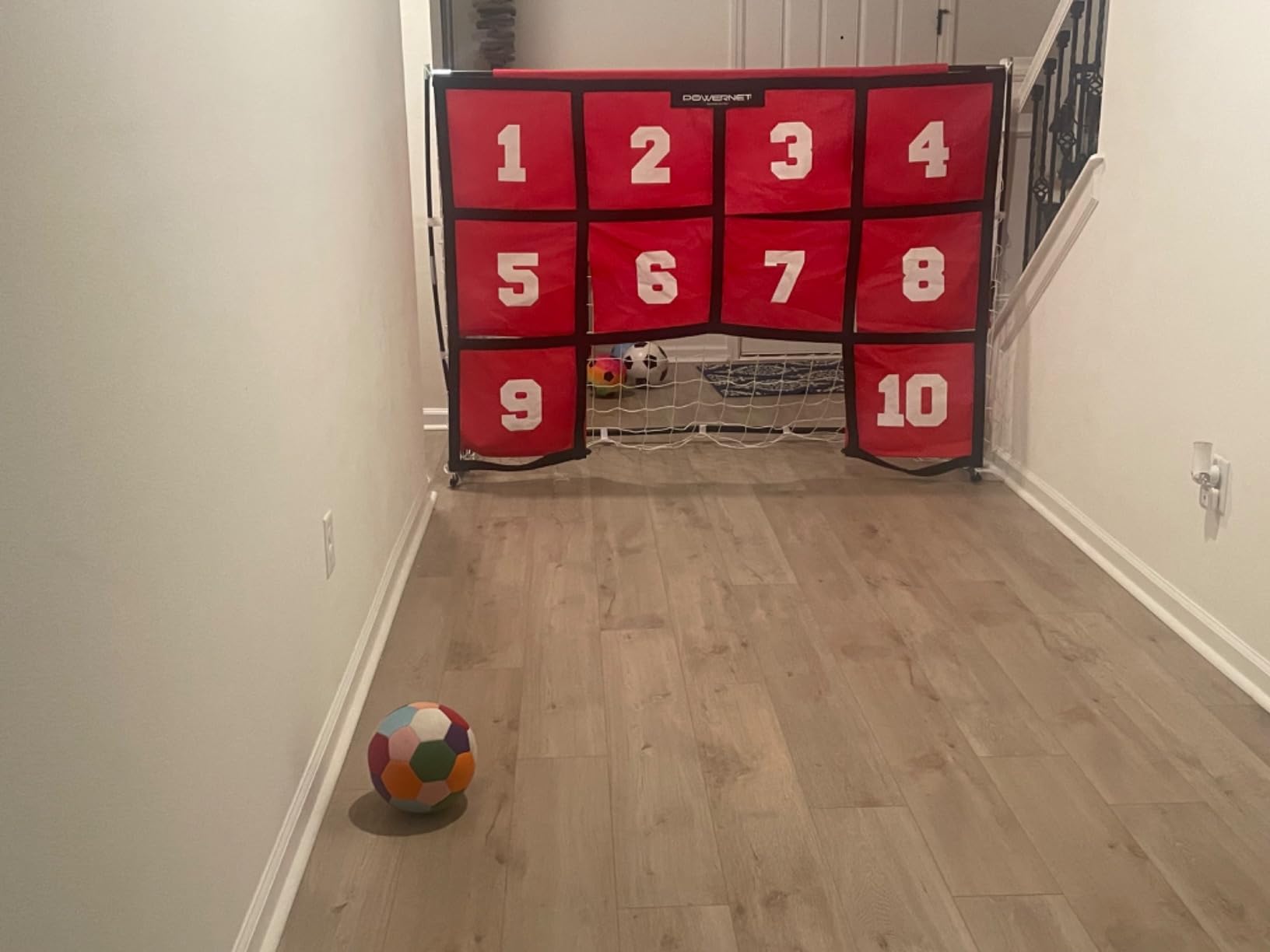
The PowerNet uses ten numbered zones, each listed by the manufacturer at approximately 14×15 inches. A player can call a number, take a fixed number of shots, and record exact hits. A rear net catches successful attempts instead of intentionally returning them.
Why this type is different: the numbers make intent visible. A shot into the goal is not automatically a successful repetition; it must reach the assigned zone. That makes the format useful for placement, weaker-foot comparisons, decision games, and team competitions.
Tradeoff: it is a compact training goal rather than a match-size goal or rebounder. It does not recreate goalkeeper positioning, full-size shooting angles, or continuous return-pass work. The lightweight portable frame also requires correct stabilization, inspection, breakdown, and storage.
Choose it when: the main goal is to make finishing accuracy scoreable.
View PowerNet on Amazon ↗ · Read our PowerNet value guide
2. SKLZ Quickster Soccer Trainer: for solo return repetitions
The SKLZ Quickster is a rebound trainer rather than a scoring goal. Its separate return surfaces are intended for ground passing and balls arriving at different heights, allowing a player to work on passing, receiving, settling, volleys, and first-touch direction without a partner.
Why this type is different: the return creates the next action. A pass into the net becomes a receiving repetition, followed by another pass. Cone gates beside the player can turn a general rebound session into a measurable first-touch exercise.
Tradeoff: rebound pace and path can change with net tension, anchoring, surface, angle, and strike quality. It also does not provide the ten clearly numbered finishing zones found on the PowerNet.
Choose it when: the player needs many solo touches, especially passes and controlled returns.
View SKLZ Quickster on Amazon ↗ · Compare a target goal with a rebounder
3. Franklin Heavy Duty Steel Rebounder: for a larger station
The Franklin model linked here is a large steel rebounder intended to provide a broad return surface. That makes it more suitable than a compact trainer when several players rotate through passing, receiving, shooting, or goalkeeper-handling exercises.
Why this type is different: a larger face is more forgiving and can support higher-volume group work. It can also accept passes from a wider range of starting positions than a small precision rebounder.
Tradeoff: the larger frame requires more usable practice area and more storage space. A generous return surface may also be less demanding for passing accuracy unless the coach marks a smaller legal target or uses a manufacturer-approved accessory.
Choose it when: the training area can accommodate a larger steel station and multiple players need to rotate efficiently.
View the Franklin rebounder on Amazon ↗ · Franklin Sports ↗
4. QUICKPLAY KICKSTER Elite 6×4: for a portable playable goal
The KICKSTER Elite is an open portable goal rather than a specialized target or rebound station. QUICKPLAY describes the 6×4 model as a fast-setup goal with a weighted base and rubber feet for stability across common playing surfaces.
Why this type is different: it supports small-sided games, general shooting, and a recognizable goal mouth without forcing every repetition into a fixed target or return pattern. Cones can create temporary scoring zones when structured finishing is needed.
Tradeoff: it does not include numbered targets or return the ball. Its value comes from portability and flexible play, so a buyer who only wants precise finishing feedback may prefer the PowerNet, while a player seeking solo passing repetitions may prefer a rebounder.
Choose it when: the same equipment must serve practice, park sessions, and small-sided games.
View the KICKSTER Elite 6×4 from QUICKPLAY ↗
5. Open Goaaal 3-in-1: for backyard ball containment
Open Goaaal combines a goal, rebound area, and surrounding backstop. The concept is less about fitting a small training aid into a carry bag and more about creating a dedicated backyard station that keeps more successful shots and misses within the practice area.
Why this type is different: the backstop changes training flow. When fewer balls leave the practice space, the player can spend less time retrieving misses. The integrated rebound section also broadens the station beyond ordinary goal shooting.
Tradeoff: this format requires substantially more yard space, installation planning, and budget than a compact portable goal or rebounder. Buyers should measure the complete structure and safety clearance—not only the visible goal opening—and confirm installation requirements for their property.
Choose it when: a household wants a more permanent backyard practice area and ball containment is a major priority.
View current Open Goaaal systems ↗
Decision guide: match the net to the problem
| If the main problem is… | Start with… | Reason |
|---|---|---|
| Shots lack a specific aim point | PowerNet numbered target goal | Ten zones support called targets and exact-hit scoring |
| Solo training lacks return passes | SKLZ Quickster | The rebound creates repeated passing and receiving actions |
| A team needs a broad return station | Franklin large rebounder | The larger face supports player rotations and varied services |
| The equipment must also serve as a game goal | QUICKPLAY KICKSTER Elite | An open goal is more flexible for small-sided play |
| Missed shots regularly leave the yard | Open Goaaal 3-in-1 | The surrounding backstop prioritizes containment |
Four questions to ask before buying
- Which action needs more repetitions? Shooting placement, passing, first touch, games, or ball containment should determine the equipment category.
- What happens to the ball after contact? Decide whether you want it caught, returned, allowed into an open goal, or stopped by a backstop.
- Where will the equipment live? Measure the playing area, safety clearance, storage space, gates, vehicle space, and permitted anchoring method.
- How much setup will actually happen? A sophisticated product provides no training value if its assembly or storage requirements prevent regular use.
Frequently asked questions
Is a rebounder better than a target goal?
Neither is universally better. A rebounder is generally more useful for repeated passes, receiving, and first touch. A numbered target goal is more direct for called-zone finishing and measurable shot placement.
Is a 6×4 goal large enough?
It can be useful for compact accuracy work and small-sided play, depending on the design. It does not reproduce the dimensions, angles, or goalkeeper coverage of a match-size goal. Our 6×4 goal-size guide explains that tradeoff in detail.
Can these nets remain outside?
Do not assume that every product is permanent or all-weather. Follow the exact manufacturer instructions for assembly, anchoring, maintenance, weather, and storage. PowerNet, for example, describes its equipment as portable and says it should be taken down after use.
Should price determine the choice?
Price matters only after the equipment type matches the training goal and space. A less expensive rebounder is poor value when the player needs a portable game goal, and a premium backstop system may be unnecessary when the main need is a small called-target station. Compare current prices and return policies after narrowing the category.
Bottom line
The most useful soccer net is the one that produces the repetition the player currently lacks. The PowerNet creates measurable finishing targets. The SKLZ and Franklin rebounders create return touches at different scales. The QUICKPLAY KICKSTER provides a flexible portable goal. Open Goaaal turns a larger backyard area into a combined goal, rebounder, and backstop.
Choose by training action, ball behavior, space, setup, and storage. That method is more reliable than accepting a single “best soccer net” ranking for five products designed to do different jobs.
For model-by-model recommendations focused on specific skills, also see our five soccer training nets by training goal and accuracy-net comparison.